
A Roadmap to Smart and Sustainable Manufacturing
In the rapidly evolving landscape of modern manufacturing, organizations are under increasing pressure to meet the demands of customization, speed, quality, and sustainability. This challenge has catalyzed the convergence of three powerful methodologies: Lean, Six Sigma, and Industry 4.0 (I4.0) technologies. While Lean and Six Sigma have long been the cornerstones of operational excellence, Industry 4.0 introduces a paradigm shift by embedding intelligence, real-time data, and automation into the manufacturing ecosystem.Why Integration Matters
Lean focuses on waste elimination, Six Sigma addresses process variability, and Industry 4.0 brings digital intelligence to every node of the value chain. Each method holds its own strengths—but when combined, they create a smart, agile, and sustainable production model.
The synergy between these methodologies is no longer optional—it’s strategic. As manufacturers seek to meet market volatility, customer expectations, and sustainability goals, the alignment of Lean Six Sigma (LSS) with Industry 4.0 becomes a blueprint for competitive advantage.

Image: storyset sur Freepik
1. From Lean Tools to Smart Technologies
Lean manufacturing, derived from the Toyota Production System (TPS), is centered around delivering value by eliminating the « 7 Wastes » (defects, overproduction, waiting, non-utilized talent, transportation, inventory, and motion). It uses tools like Value Stream Mapping (VSM), 5S, Kanban, Just-in-Time (JIT), and Cellular Manufacturing to streamline processes.
Six Sigma adds a statistical edge, employing the DMAIC (Define-Measure-Analyze-Improve-Control) framework to systematically reduce process variation and defects.
Enter Industry 4.0—characterized by technologies such as:
• Cyber-Physical Systems (CPS)
• Industrial Internet of Things (IIoT)
• Cloud Computing & Big Data Analytics
• Artificial Intelligence & Machine Learning
• Collaborative Robots (COBOTs)
• Additive Manufacturing & 3D Printing
These technologies provide real-time insights and automation capabilities, enabling Lean and Six Sigma methodologies to reach new levels of precision, speed, and adaptability.
2. Lean + Industry 4.0: A Match Made in the Smart Factory
Industry 4.0 transforms traditional Lean practices into digital enablers:
• Kanban → Cloud-Based Kanban: Enables real-time inventory management and production signals across distributed networks.
• JIT → Smart Scheduling: IIoT sensors and AI-driven demand forecasting enhance synchronization across the supply chain.
• 5S → Digital Visual Management: Augmented reality (AR) and smart dashboards digitize workplace organization and efficiency metrics.
• Waste Elimination → Data-Driven Waste Detection: Smart sensors detect inefficiencies and trigger instant corrective actions.
By integrating I4.0 with Lean, companies are moving from reactive to predictive and autonomous operations, which drastically reduces downtime, improves throughput, and lowers costs.
3. Six Sigma Meets Digital Intelligence
Six Sigma’s reliance on data analytics makes it a natural ally of Industry 4.0. However, the size and complexity of data generated in smart factories surpass traditional statistical tools. This is where Big Data, AI, and machine learning step in:
• Real-Time Data Collection: IIoT sensors capture data at every process touchpoint, enabling immediate root cause analysis.
• Predictive Analytics: Algorithms forecast quality deviations before they occur.
• Automated Control: Feedback loops are built into CPS to autonomously adjust process parameters, ensuring consistent quality.
This digital reinforcement of Six Sigma enhances process stability and precision while accelerating the decision-making cycle.
4. Overcoming Lean Implementation Challenges with I4.0
Despite Lean’s proven benefits, many organizations—especially SMEs—struggle with its implementation due to:
• Resistance to change
• Data availability issues
• Workforce skill gaps
• Difficulty sustaining improvements
Industry 4.0 helps bridge these gaps:
Lean Challenge I4.0 Solution
Poor data visibility IIoT sensors and cloud platforms for real-time data
Manual process monitoring AI-powered dashboards and digital twins
Long setup/changeover times SMED with smart automation and robotics
Unbalanced workflow AI-driven production scheduling
Workforce resistance AR/VR for immersive training and upskilling
The result? A digitally-augmented Lean system that is more responsive, resilient, and sustainable.
5. Sustainability: The Overlooked Advantage
Industry 4.0 not only improves efficiency—it also enhances sustainability:
• Energy Optimization: Smart sensors monitor and control energy usage in real time.
• Resource Efficiency: Additive manufacturing reduces raw material waste.
• Workforce Empowerment: Digital training tools increase engagement and skill development.
• Circular Economy Support: Advanced analytics and traceability improve product lifecycle management.
Combined with Lean’s waste-reduction focus and Six Sigma’s quality emphasis, I4.0 paves the way for triple bottom line impact: People, Planet, and Profit.
6. The Road Ahead: What Should Companies Do?
As Industry 4.0 redefines manufacturing, here’s how organizations can strategically integrate LSS with digital transformation:
- Assess Digital Readiness: Map current Lean initiatives and identify digital gaps.
- Upskill Workforce: Invest in LSS training with a digital literacy focus.
- Start Small, Scale Fast: Pilot projects such as cloud-based Kanban or predictive maintenance.
- Invest in Infrastructure: Build CPS and IoT foundations to collect actionable data.
- Promote Cross-Functional Collaboration: Break down silos between IT, operations, and quality teams.
Conclusion
The fusion of Lean, Six Sigma, and Industry 4.0 offers a transformative pathway toward smart, sustainable, and customer-centric manufacturing. Together, they unlock a powerful synergy—one that enables companies to operate with intelligence, speed, and agility in the digital age.
While challenges remain, the opportunity for value creation, innovation, and sustainability has never been greater. Manufacturers who embrace this convergence will not only outperform their competitors—they’ll define the next generation of industrial excellence.
Bibliography
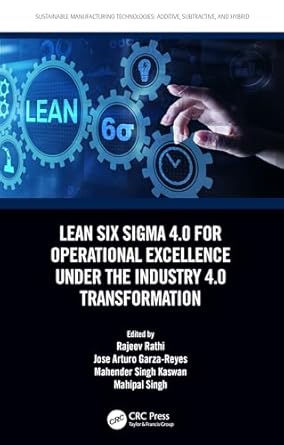
Lean Six Sigma 4.0 for Operational Excellence Under the Industry 4.0 Transformation (Sustainable Manufacturing Technologies) edited by Rajeev Rathi, Jose Arturo Garza-Reyes, Mahender Singh Kaswan, and Mahipal Singh
 YAT Conseil